

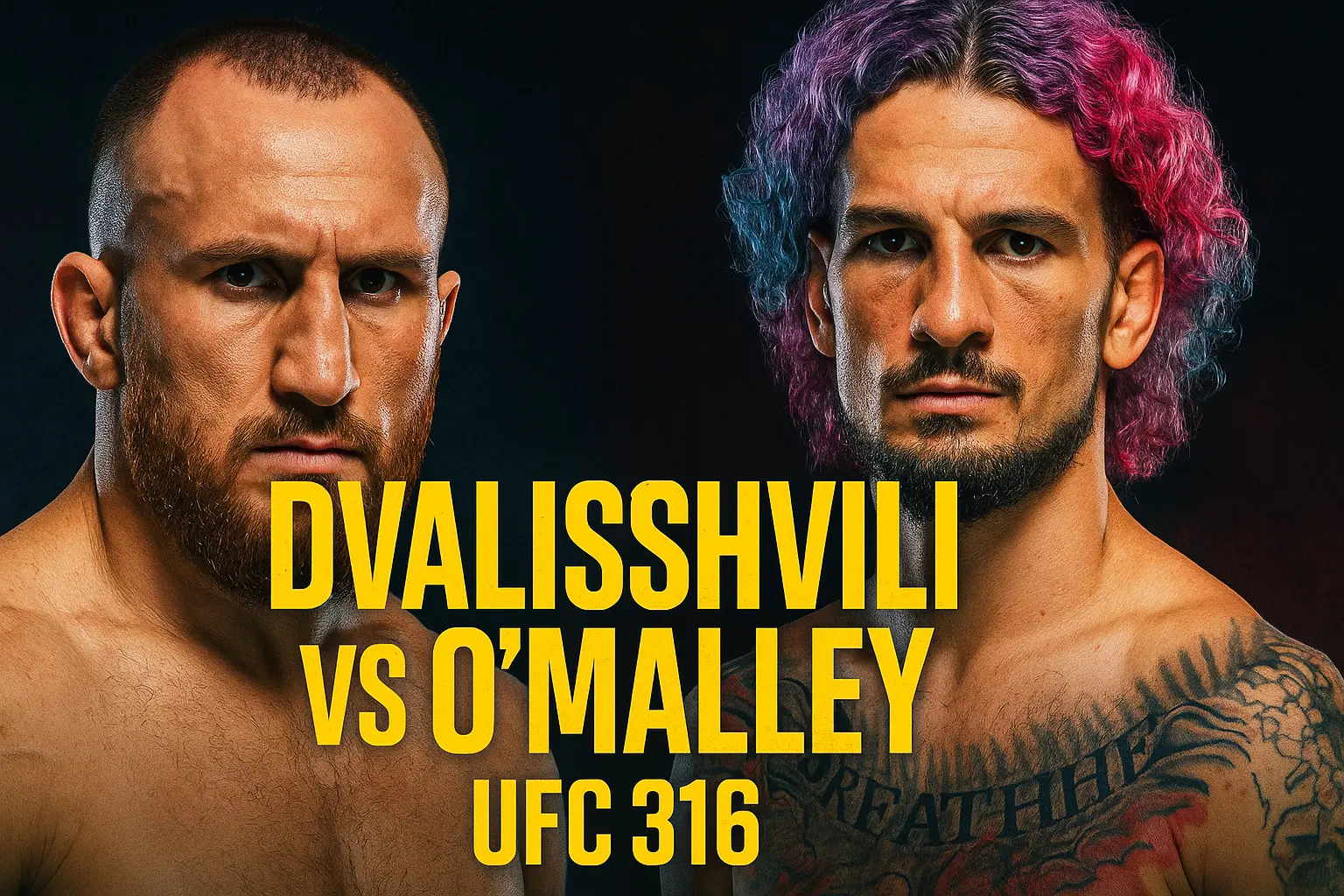
Merab Dvalishvili defends bantamweight belt via submission over Sean O’Malley in Newark. Full results, analysis, and what’s next.
In what many billed as a marketing rematch rather than a merit-based one, Merab Dvalishvili proved that dominance isn’t just repeatable — it can be perfected. With a north-south choke submission in Round 3, he didn’t just defeat Sean O’Malley again — he erased doubts, silenced narratives, and reshaped the future of the bantamweight division.
The Fight: Technical Precision Meets Psychological Warfare
From the opening seconds at the Prudential Center, it was clear that Dvalishvili was not just here to win — he was here to expose the myth of “Suga Sean.” No spinning back kicks, no viral knockouts — O’Malley found himself in a psychological and tactical trap. Dvalishvili’s approach was not to stand and trade but to smother — and he executed with surgical precision.
What made this fight different from their first clash wasn’t just the submission — it was the calculated patience Merab showed. In Round 1, he absorbed O’Malley’s range attacks while testing takedown angles. By Round 2, Sean’s footwork slowed subtly, a sign of Dvalishvili’s grappling threat sinking into his rhythm. And by Round 3, the Georgian’s chain-wrestling culminated in a transition to a rarely used north-south choke — a finish that left analysts stunned.
What the Cameras Didn’t Catch: Between Rounds Tension and Corner Breakdown
Sources close to both camps revealed tension in O’Malley’s corner between his head coach and grappling consultant. The decision to continue relying on feints and kicks, despite their ineffectiveness, became a point of quiet debate between rounds. According to a behind-the-scenes team member, O’Malley was hesitant to change strategy, fearing a mid-fight identity crisis.
Merab’s team, on the other hand, remained eerily calm. “Round 3. Let him spin again. Then bury him,” his coach was heard saying. And that’s precisely what happened.
Beyond the Cage: Dvalishvili’s Evolution Is a Message to Matchmakers
This wasn’t just a win — it was a message to the UFC’s matchmaking philosophy. Giving O’Malley an immediate rematch was criticized by many fighters, and this outcome validated their frustration. The reality? Dvalishvili never needed a second fight to prove who was better. But now that he’s done it twice — with a finish — his claim to being the most dangerous bantamweight in history just got very real.
More importantly, this win shifts the division. With Cory Sandhagen, Umar Nurmagomedov, and even a possible returning Henry Cejudo waiting in the wings, Merab’s victory has detonated a fuse across three fight camps.
Kayla Harrison’s Surprise Call-Out and What It Means
Another underreported story of the night was Kayla Harrison’s post-fight callout of Amanda Nunes, right after securing a second-round kimura over Julianna Peña. While most media focused on the submission, few realized this marks the first time Harrison publicly challenged Nunes by name, saying, “There’s no queen left but one — I’m coming.”
With Nunes now deep in negotiation talks with UFC brass, insiders believe UFC 318 may feature a double-headliner: Dvalishvili’s next title defense and Harrison vs. Nunes — possibly the most marketable women’s fight in MMA history.
Unexpected Appearance: Trump’s Return Sparks Unseen Protocol Shift
Former President Donald Trump attended UFC 316 — but what wasn’t shown on most broadcasts was the heightened backstage security and sudden locker room reshuffling minutes before the co-main. Fighters were reportedly moved between warm-up zones to accommodate last-minute Secret Service directives.
It’s also believed that the delay in the co-main walkout had nothing to do with production, but was due to “a stalled clearance sweep” as Trump moved through the bowels of the Prudential Center. UFC President Dana White, a known Trump ally, was said to be frustrated but supportive, knowing the buzz it brought in media viewership.
O’Malley’s Future: Rebuild or Reinvent?
There’s no shame in losing to Dvalishvili — twice. But the nature of the loss raises existential questions about Sean O’Malley’s brand versus his reality. Known for viral knockouts and flamboyant entrances, his last two fights have now ended in suffocating grappling defeats.
UFC insiders suggest O’Malley may take a year off to work solely on jiu-jitsu and defensive wrestling. Others whisper a move to featherweight could refresh his career. Either way, the “Suga Show” is paused — and may return under a different title.
UFC 316 will be remembered not for the hype, but for the clarity it delivered. Dvalishvili is not just champion — he’s a system-breaker. O’Malley is not just marketable — he’s vulnerable. And for the bantamweight division, a new era has begun.