

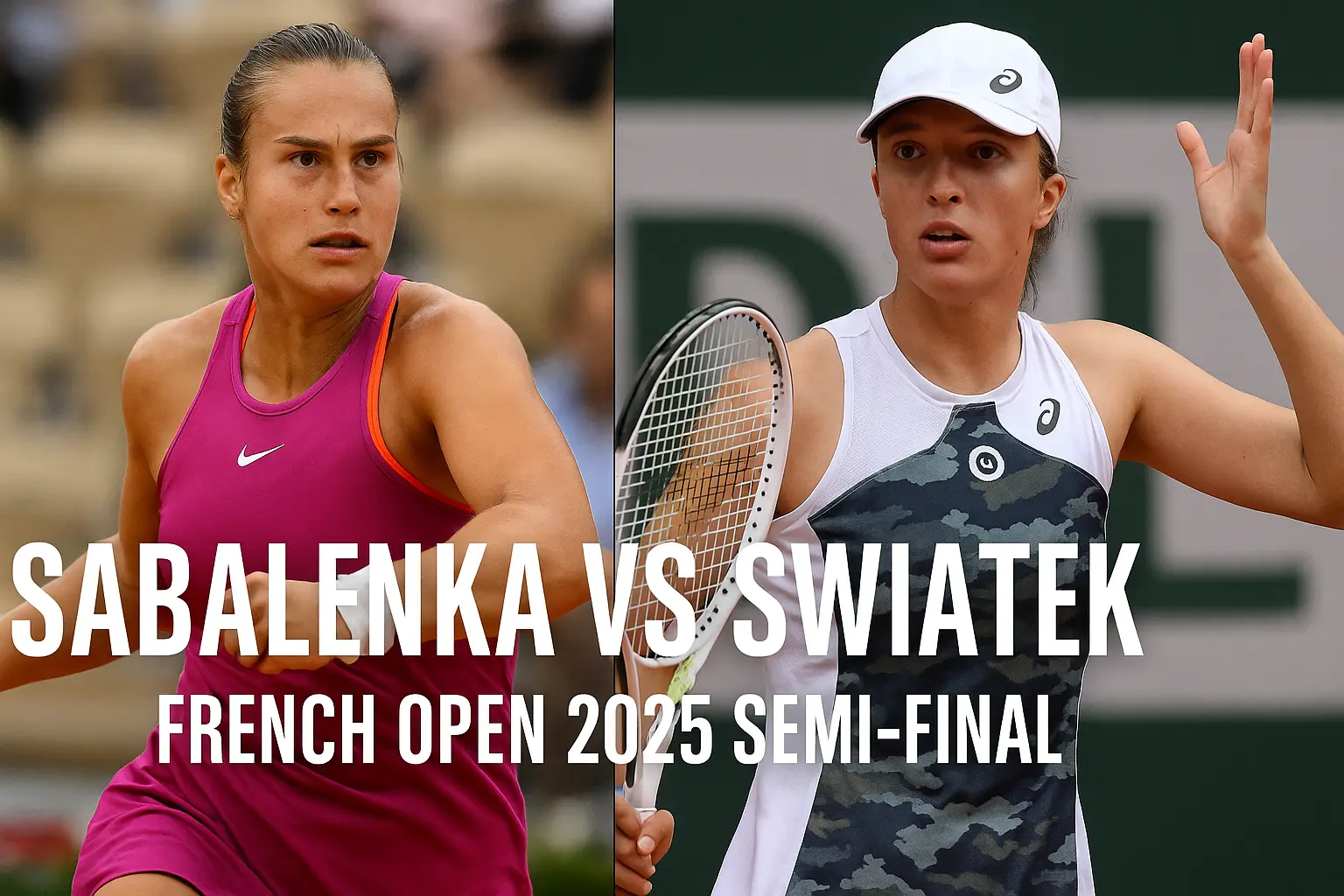
The 2025 French Open has brought to the forefront one of the most compelling rivalries in modern tennis: Aryna Sabalenka vs Iga Swiatek. As they face off in the semi-finals, this match is more than a battle for a spot in the final—it’s a clash of styles, histories, and legacies.
Tennis rivalries often capture our imagination because they represent more than just competition—they embody contrasting approaches to the game, divergent personalities, and the relentless pursuit of greatness. The emerging duel between Iga Świątek and Aryna Sabalenka is no exception. While their on-court battles have become must-watch events, what makes this rivalry truly fascinating lies beneath the surface—in their personal journeys, psychological evolution, and what their clashes reveal about the modern women’s game.
The Making of Two Champions: Contrasting Paths to the Top
Iga Świątek’s rise to tennis royalty wasn’t just about raw talent—it was a product of discipline, intelligence, and an unshakable mental game. Growing up in Poland, she was influenced by her father, an Olympic rower, who instilled in her the importance of structure and preparation. Unlike many players who rely purely on power, Świątek’s game is built on precision, spin, and tactical brilliance. She doesn’t just hit winners; she constructs points like a chess player, anticipating her opponent’s moves two steps ahead.
But what truly sets her apart is her mental resilience. After winning the 2020 French Open as a teenager, she faced immense pressure to maintain her dominance. Instead of crumbling, she doubled down, working with a sports psychologist to harness her emotions rather than suppress them. This is why, even when Sabalenka is blasting 120 km/h forehands, Świątek stays calm—her mind is her biggest weapon.
Aryna Sabalenka’s journey, on the other hand, is one of raw power, emotional fire, and relentless self-reinvention. Born in Belarus, she was always the aggressor on court, swinging with fearless intensity. But behind the scenes, her career nearly unraveled in 2022 due to crippling self-doubt and the lingering grief of losing her father. Many players would have faded away, but Sabalenka did something rare—she publicly acknowledged her struggles and rebuilt her game from the ground up.
Her breakthrough at the 2023 Australian Open wasn’t just a triumph of skill; it was a testament to her mental comeback. She learned to channel her aggression, reduce unforced errors, and—most crucially—trust herself in big moments. Now, as she faces Świątek at Roland Garros, the question isn’t just about tennis—it’s about whether she can conquer the last mental barrier: beating the world’s best on clay.
Why Their Rivalry Feels Different
Most tennis rivalries are defined by contrasting styles—Federer’s elegance vs. Nadal’s intensity, Serena’s power vs. Sharapova’s grit. But Świątek vs. Sabalenka is unique because it’s a battle of two modern titans who represent different philosophies of the game.
Świątek is the master of control, using spin, angles, and consistency to break opponents down. Sabalenka is the queen of destruction, relying on sheer power to bulldoze through defenses. When they play, it’s not just about who wins—it’s a clash of two competing visions of how tennis should be played.
Their matches also carry an emotional weight that most rivalries lack. Świątek, the stoic technician, rarely shows vulnerability. Sabalenka, the fiery competitor, wears her heart on her sleeve. When they face off, it feels like more than a tennis match—it’s a psychological duel, where every point tests their nerves as much as their skills.
The French Open Showdown: What to Expect
Historically, Świątek has dominated Sabalenka on clay, winning four of their five meetings on the surface. The reason? Clay neutralizes Sabalenka’s power, forcing her into longer rallies where Świątek’s consistency shines. But this year could be different. Sabalenka has improved her movement and patience, and if she can keep her error count low, she has the firepower to blast through Świątek’s defenses.
The key battle will be Sabalenka’s serve vs. Świątek’s return. If Sabalenka lands 70% of her first serves, she can dictate play. But if Świątek starts reading her serve early, she’ll drag Sabalenka into grueling baseline exchanges—where she has the upper hand.
The Bigger Picture: What This Match Means for Tennis
This isn’t just another Grand Slam clash—it could be the start of a defining rivalry in women’s tennis. With Serena Williams retired and Ashleigh Barty gone, the WTA needs new marquee matchups, and Świątek vs. Sabalenka delivers exactly that. If Sabalenka wins, it proves she can conquer all surfaces, not just hard courts. If Świątek triumphs, it cements her as the undisputed queen of clay.
But beyond rankings and trophies, their rivalry symbolizes something deeper—the evolution of women’s tennis into a sport where power, skill, and mental strength collide at the highest level.
Final Thoughts: Who Will Win?
The smart money is on Świątek in three sets—her clay-court mastery and mental edge make her the favorite. But if Sabalenka brings her A-game, we could witness an all-time classic. One thing’s for sure: when these two step on court, tennis wins.
Further Reading: Iga Swiatek’s Career Overview