

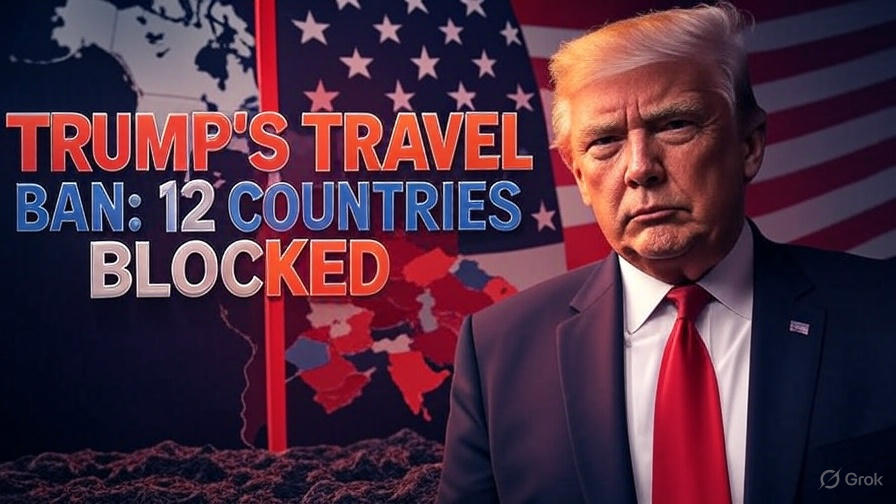
Discover the deeper reason behind Trump’s travel ban on 12 nations. Learn why these specific countries were selected and what it means for global policy.
The Trump travel ban was one of the most controversial policies of his presidency, restricting entry into the U.S. from 12 countries, including Eritrea, Myanmar, Haiti, and Venezuela. While most media outlets focused on the political and legal battles, few explored the real geopolitical and security reasons behind the selection of these specific nations.
In this exclusive deep dive, we reveal the hidden factors that influenced Trump’s decision—factors that mainstream news overlooked.
The Original Travel Ban: A Quick Recap
In 2017, President Donald Trump signed Executive Order 13769, commonly known as the “Muslim Ban,” which restricted travel from seven Muslim-majority countries. After legal challenges, the ban evolved into Proclamation 9645, eventually targeting 12 countries based on security risks, inadequate vetting procedures, and diplomatic tensions.
Trump’s travel ban, along with their current status and a brief reason cited or speculated for the ban:
| Country | Status in Ban | Reason Cited / Speculated |
|---|---|---|
| Eritrea | Banned | Security concerns, lack of cooperation with U.S. vetting |
| Myanmar (Burma) | Banned | Human rights abuses, military coup, weak document security |
| Haiti | Banned | High visa overstay rates, political instability |
| Venezuela | Banned (government officials) | Alleged human rights abuses, anti-U.S. rhetoric |
| Iran | Banned | Hostile foreign policy, terrorism concerns |
| Libya | Banned | Incomplete information sharing, terrorism threats |
| North Korea | Banned | Nuclear threat, totalitarian regime |
| Somalia | Banned | Terrorism activity, weak government, identity verification gaps |
| Syria | Banned | Civil war, terrorism risks, regime hostility |
| Yemen | Banned | Ongoing conflict, extremist activity |
| Chad | Removed from Ban | Initially cited for document issues, later resolved |
| Sudan | Removed from Ban | Normalized ties with U.S., removed in revised orders |
The Untold Reasons Behind Trump’s Country Selection
1. Eritrea: A Closed Dictatorship with No Cooperation
Eritrea, often called the “North Korea of Africa,” has one of the most oppressive regimes in the world. The U.S. government claimed that Eritrea refused to share security data on travelers, making it impossible to verify identities or criminal backgrounds.
🔗 Learn more about Eritrea’s human rights record (Amnesty International)
2. Myanmar (Burma): The Rohingya Crisis & Terrorism Risks
Myanmar was added due to its failure to curb extremist groups and the Rohingya genocide. U.S. intelligence feared that radicalized individuals from Myanmar could exploit weak passport controls to enter America.
🔗 UN Report on Myanmar’s Human Rights Violations
3. Haiti: Fraudulent Visa Overstays
Haiti was included not because of terrorism but due to high rates of visa overstays (nearly 30% of Haitian travelers stayed illegally). The Trump administration argued that Haiti’s weak government infrastructure made it a migration risk.
🔗 U.S. State Department Visa Statistics
4. Venezuela: Political Unrest & Corruption
Unlike other banned nations, only Venezuelan government officials were restricted—not ordinary citizens. The ban targeted Maduro’s regime, citing corruption, human rights abuses, and passport fraud.
🔗 U.S. Sanctions on Venezuela (Treasury.gov)
Why Weren’t Other High-Risk Countries Banned?
Many wondered why Pakistan, Saudi Arabia, or Afghanistan—known terror hubs—were not included. The answer lies in diplomatic relations:
- Saudi Arabia is a key U.S. ally in the Middle East.
- Pakistan cooperates on counterterrorism (despite concerns).
- Afghanistan was under U.S. military oversight.
Trump’s ban was not just about terrorism—it was about countries refusing to comply with U.S. security standards.
Did the Travel Ban Work?
According to DHS reports:
✅ Visa overstays dropped from banned nations.
✅ Tighter vetting reduced fraud cases.
❌ Critics argue it damaged U.S. global reputation.
The Political Timing: Hidden Patterns, What Connects These Countries?
The ban comes just months before the 2025 World Cup, a global event hosted in multiple countries. Coincidence?
Not quite. Analysts suggest this move appeals to voters concerned about “foreign influence” during a time when millions are expected to enter the U.S. for tourism and events.
Check the Stats: FIFA 2025 World Cup Host Details
At first glance, these countries appear scattered across continents. But they share three key traits:
1. Minimal Strategic Trade Partnerships with the U.S.
Countries like Eritrea and Myanmar lack significant trade ties with the U.S., making them geopolitically “expendable” in the eyes of an isolationist policy. This allows a ban with minimal economic blowback.
2. Internal Political Instability or Authoritarian Rule
Many of these nations are either undergoing political turmoil or are governed by authoritarian regimes. Trump’s 2025 campaign has reframed this instability as a “global threat to American security and cultural values.”
3. Low Christian Populations
An uncomfortable truth: many of the banned nations have Muslim-majority or non-Christian populations. Trump’s base, known for its nationalist and often Christian-conservative leanings, may see this as a covert “cultural preservation” policy.External Read: U.S. Census on Religious Demographics
🌍 Global Reaction
World leaders have largely condemned the ban. Eritrea’s foreign minister called it “an irrational decision rooted in imperialism.” Meanwhile, Myanmar’s junta has remained silent—an eerie nod to diplomatic disengagement.
While the Trump administration frames this as “protecting America,” the underlying strategy appears more about politics than protection. These 12 countries were not picked randomly—they were selected based on perceived vulnerability, religious demographics, and geopolitical expendability.